Homelab
Built from scratch, one node at a time
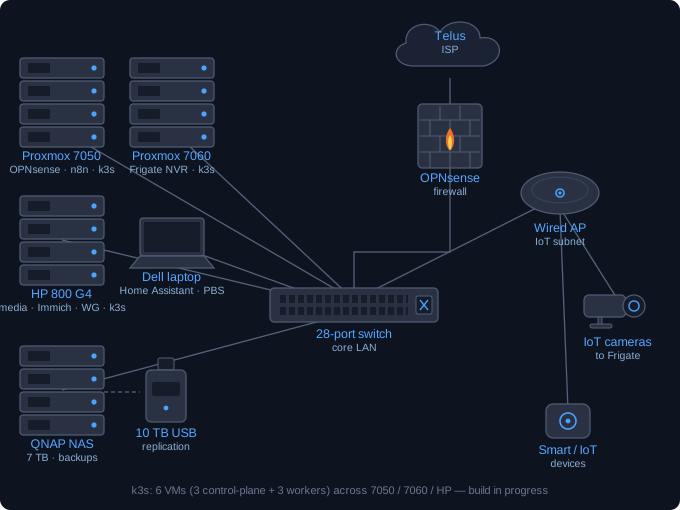
What runs on it
| Service | Runs on | What it teaches me |
|---|---|---|
| OPNsense + OpenWRT | Optiplex 7050 | Network segmentation, firewall policy, VLAN routing |
| Frigate NVR | Optiplex 7060 | Real-time video processing, storage planning, MQTT |
| n8n | Optiplex 7050 (LXC) | Workflow automation, API integration, reverse proxy |
| Home Assistant | Dell laptop | IoT orchestration, MQTT, device automation |
| Immich | HP 800 G4 Mini | Photo management, database ops, backup strategy |
| Media stack (ARR) | HP 800 G4 Mini | Docker compose, service dependencies, storage |
| WireGuard | HP 800 G4 Mini | Secure remote access, tunnel configuration |
| Proxmox Backup Server | Dell laptop → QNAP | Backup architecture, replication, disaster recovery |
| k3s cluster (6 nodes) | 7050 / 7060 / HP | Kubernetes orchestration, HA design — building |
Hardware
| Host | Model | RAM | Storage | Role |
|---|---|---|---|---|
| Proxmox 01 | Dell Optiplex 7050 | 64 GB | 12 TB | Firewall, routing, n8n, k3s |
| Proxmox 02 | Dell Optiplex 7060 | 64 GB | 12 TB | Frigate NVR, k3s |
| Proxmox 03 | HP 800 G4 Mini | 32 GB | 2 TB NVMe (ZFS mirror) | Media, Immich, VPN, k3s |
| Proxmox 04 | Dell laptop | 32 GB | 500 GB | Home Assistant, PBS |
| Storage | QNAP NAS | — | 7 TB + 10 TB USB | Backup target, replication |
All desktops and mini PCs chosen for low power consumption.
Network design
The entire lab hangs off a 28-port switch fed by a Telus ONT + hub. The Dell Optiplex 7050 runs OPNsense as the firewall with a dedicated NIC and a physically wired access point for IoT devices — cameras, smart switches, and other IoT gear get their own subnet with DHCP served by OPNsense. A virtual OpenWRT appliance handles routing between OPNsense and the AP via a static route.
Public access to n8n is proxied through Cloudflare DNS and terminated by an Nginx reverse proxy running in an LXC on the same host.
Backup & replication
Proxmox Backup Server runs on the Dell laptop, with all backup data stored on the QNAP NAS (7 TB). A continuous replication job copies everything to a 10 TB USB drive attached to the QNAP — offsite-ready if needed.
Kubernetes (k3s) — work in progress
Six virtual machines spread across three physical hosts form a k3s cluster: 3 control-plane nodes and 3 workers, with one master and one worker on each of the Optiplex 7050, Optiplex 7060, and HP 800 G4 Mini. This layout keeps etcd quorum alive even if an entire physical host goes down.
The cluster is currently under construction — services are being migrated from standalone LXC/Docker into Kubernetes in phases.